

Aspire guide
Race Day Nutrition
Race Day Nutrition manual
One Race, Many Finish Times: What a High School 5K Actually Needs
An inclusive, duration-based guide to what a typical high-school 5K needs before, during, and after the race—regardless of finish time.
Why this matters
Read time
9 min
Audience
Coach + Parent + Athlete
Use it for
Race Day Nutrition
Start here
The fuelling problem at a high school meet is not the race; it is everything around it.
Coach prompt
Tell the parent meeting once: we fuel the day around the race, not the race.
Quick reference
Topic snapshot
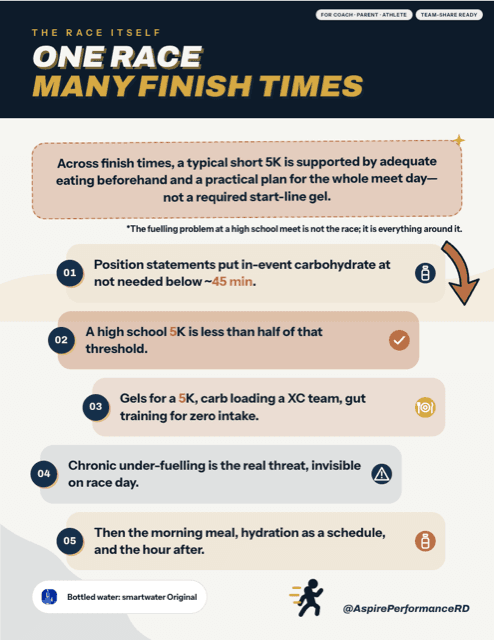
The printed sheet
Read time
9 min
Audience
Coach + Parent + Athlete
Best next move
Use it this week
Tell the parent meeting once: we fuel the day around the race, not the race.
Quick reference map
Use the topic like a clear checklist
In the library
Format
Read the topic here, then download the PDF only when you need an offline copy.
Best use
Open the sections you need, then share the same topic link with coaches, parents, or athletes.
Recognizable options
What this can look like at the store
These are familiar examples, not a required shopping list. Use the food category to find an option that fits your athlete, budget, and allergy needs.



Brands are shown only as concrete examples, not endorsements. Ingredients, labels, and availability can change; check the current package for allergens and fit. Image sources and rights notice.
Quick start
Start here
An inclusive, duration-based guide to what a typical high-school 5K needs before, during, and after the race—regardless of finish time.
The mechanism
Digestion is slower than the race
- Swallowed carbs must empty, absorb, circulate and then be burned.
- Rates that matter are reached deep into long events, not in minute two.
The guidance
Under 45 minutes, not required
- Position statements put in-event carbohydrate at not needed below ~45 min.
- A high school 5K is less than half of that threshold.
Stop doing
Five things you can drop
- Gels for a 5K, carb loading a XC team, gut training for zero intake.
- Brand debates, and treating the last hour as the big one.
Context
Overview
The original 17-minute example is one case study, not the definition of a “real” runner. The same duration-based principle applies across a team: plan the school day, travel, warm-up, recovery, and any second event around the athlete’s actual schedule and practiced tolerance.
Nearly everything a cross country coach finds when they search for endurance nutrition was written for an event lasting three hours or more.
That content has a consistent backbone: carbohydrate per hour, gels on a schedule, aid stations and feed zones, gut training to tolerate large intakes while running, multi-day carbohydrate loading. It may be useful for prolonged events, but much of it does not map cleanly onto a short high school race.
A high school 5K can take roughly sixteen to thirty-plus minutes depending on the athlete, course, conditions, and day. A 3200 is shorter still. Those event durations — not an athlete's sex, team level, or label — are what matter for the in-race fueling question.
For an event this short, carbohydrate swallowed at the start line is unlikely to be digested, absorbed, delivered, and oxidized soon enough to contribute meaningfully before the finish. That makes the surrounding day a more useful planning target than a last-second gel.

What coach says
"We are not fueling the race. We are fueling the day around it." Said once at a parent meeting, that sentence saves a program hundreds of dollars in gels nobody needed and redirects the attention to the four or five things that actually change how an athlete races.

Unlock the rest of the manual
Full access opens every section and the ebook PDF.
Evidence
References
The sources behind this topic. Where a citation carries a link, it opens the record so you can check the original.
- 1.Thomas DT, Erdman KA, Burke LM. American College of Sports Medicine Joint Position Statement. Nutrition and Athletic Performance. Med Sci Sports Exerc. 2016;48(3):543-568.PubMed 26891166
- 2.Burke LM, Hawley JA, Wong SHS, Jeukendrup AE. Carbohydrates for training and competition. J Sports Sci. 2011;29(sup1):S17-S27.doi:10.1080/02640414.2011.585473
- 3.Carter JM, Jeukendrup AE, Jones DA. The effect of carbohydrate mouth rinse on 1-h cycle time trial performance. Med Sci Sports Exerc. 2004;36(12):2107-2111.PubMed 15570147
- 4.Chambers ES, Bridge MW, Jones DA. Carbohydrate sensing in the human mouth: effects on exercise performance and brain activity. J Physiol. 2009;587(8):1779-1794.PubMed 19237430
- 5.Desbrow B, McCormack J, Burke LM, et al. Sports Dietitians Australia position statement: sports nutrition for the adolescent athlete. Int J Sport Nutr Exerc Metab. 2014;24(5):570-584.PubMed 24668620
- 6.McDermott BP, Anderson SA, Armstrong LE, et al. National Athletic Trainers' Association Position Statement: Fluid Replacement for the Physically Active. J Athl Train. 2017;52(9):877-895.PubMed 28985128
What to do next
Use it this week
Tell the parent meeting once: we fuel the day around the race, not the race.
Related tool
Race morning fuel
Turn familiar choices into a race-morning checklist.
Open race morning fuelSource topics
5k race nutrition • do runners need gels for a 5k • carb loading high school cross country • carbohydrate during short races • race day fueling myths • high school 5k fueling